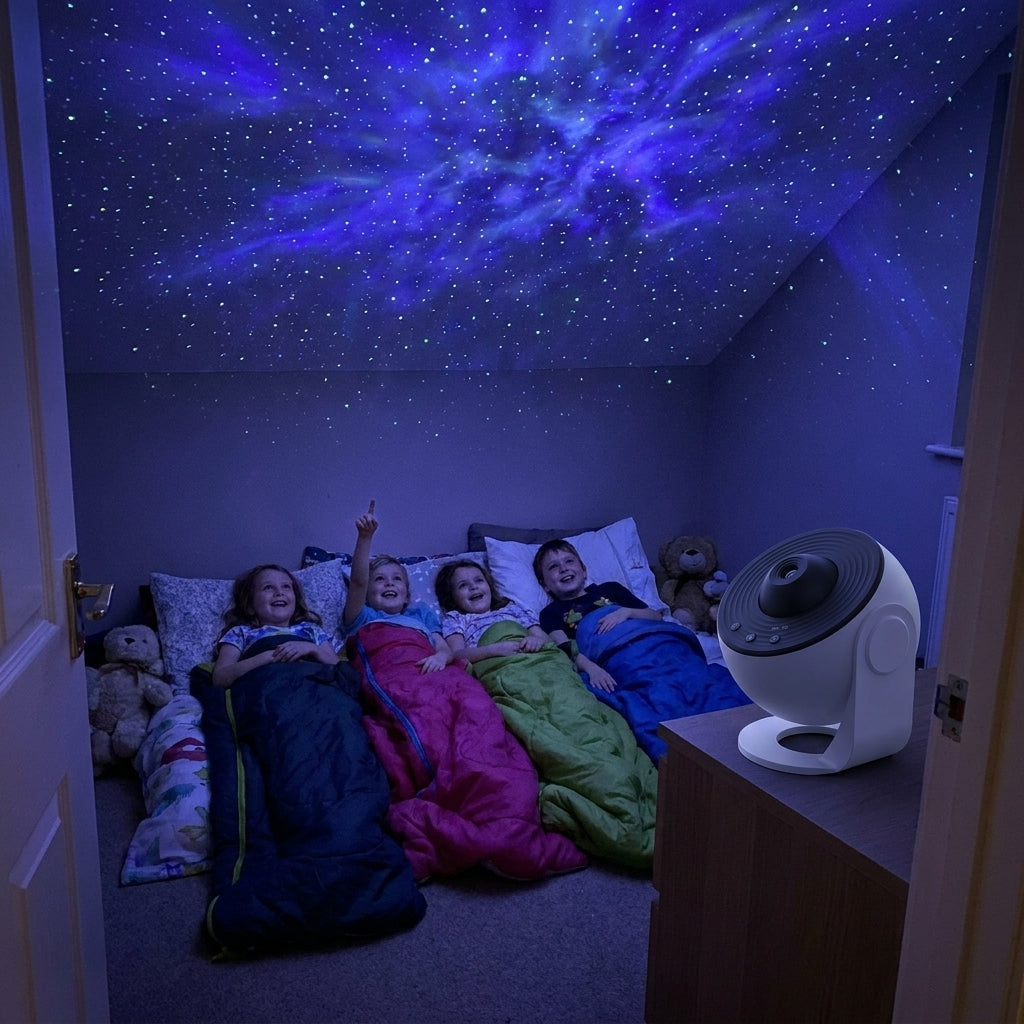
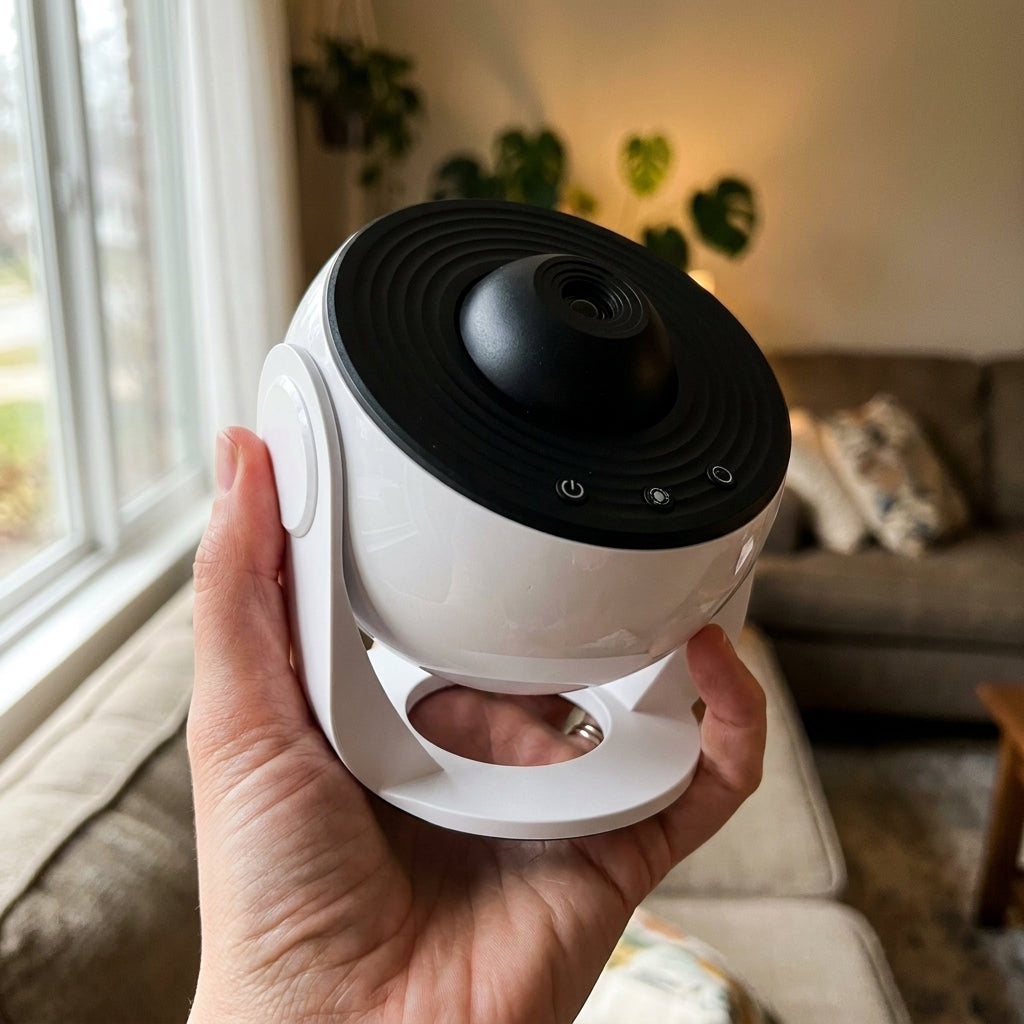
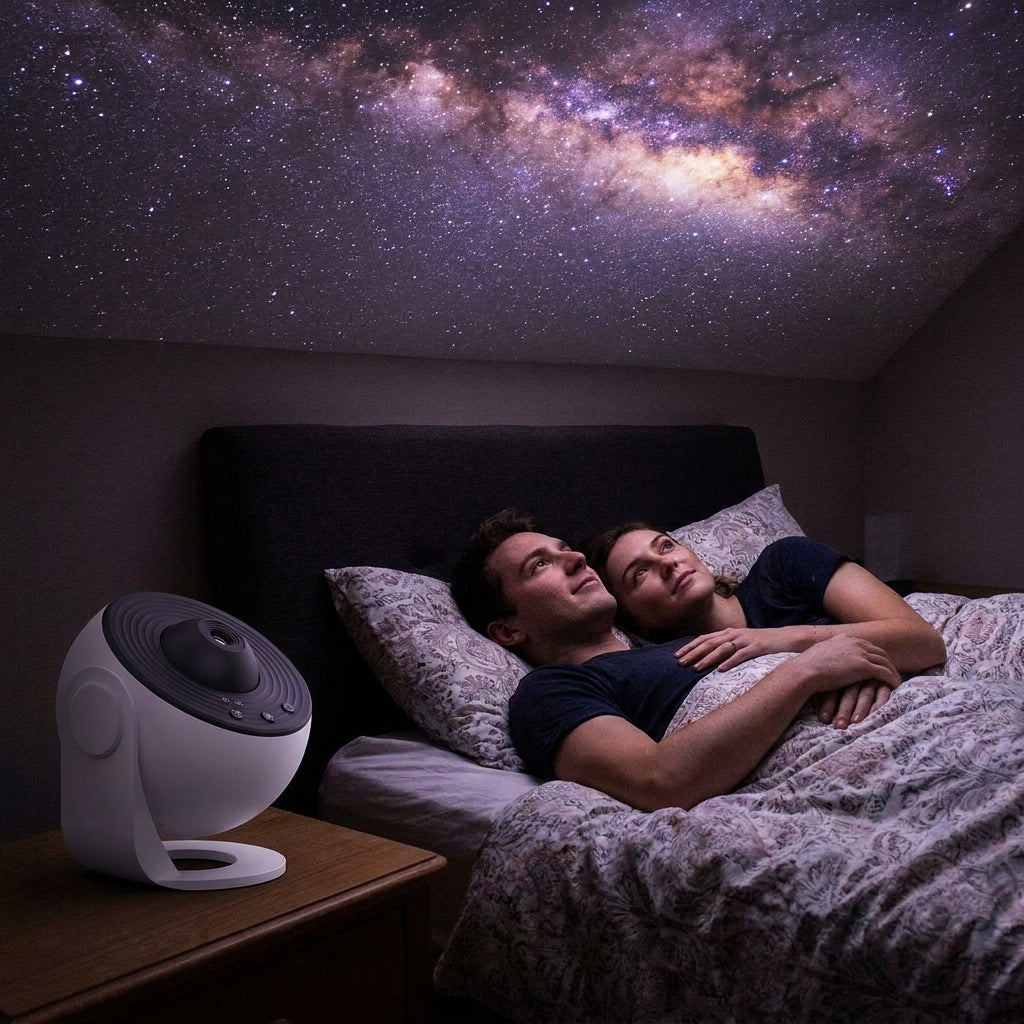
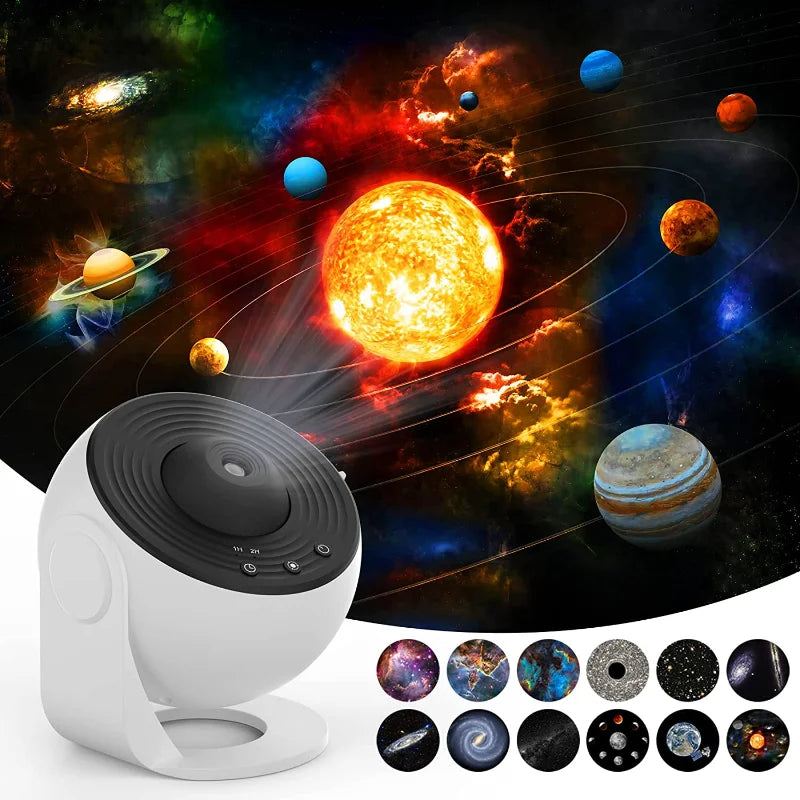
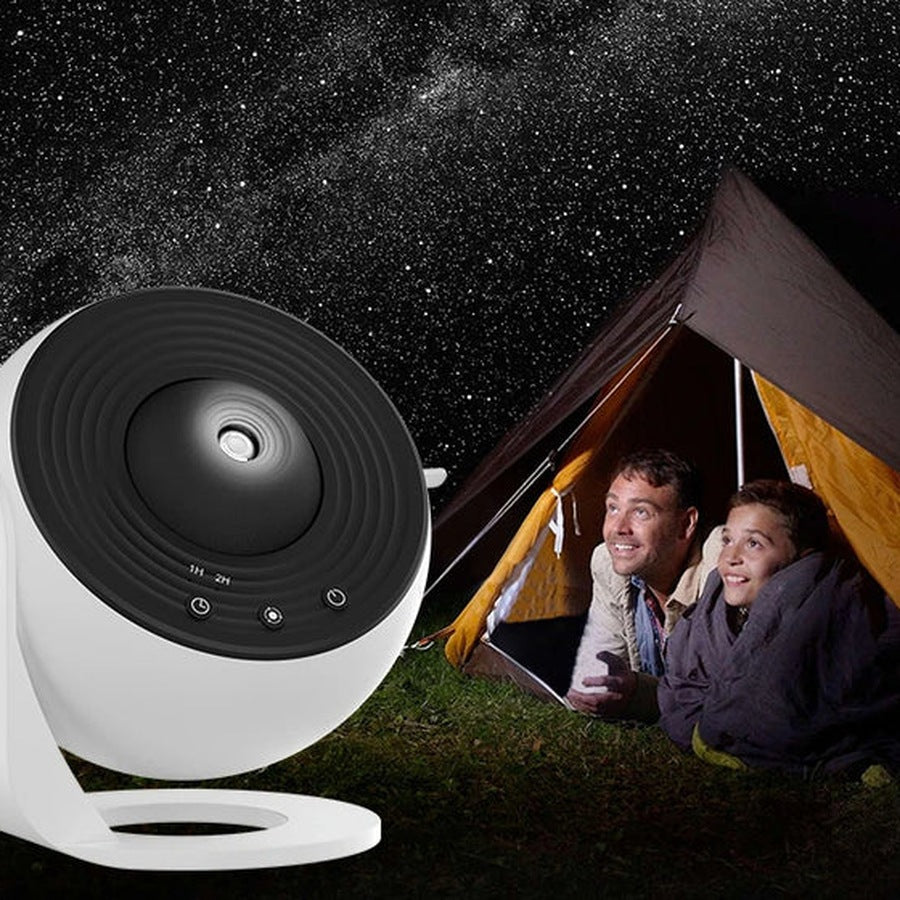
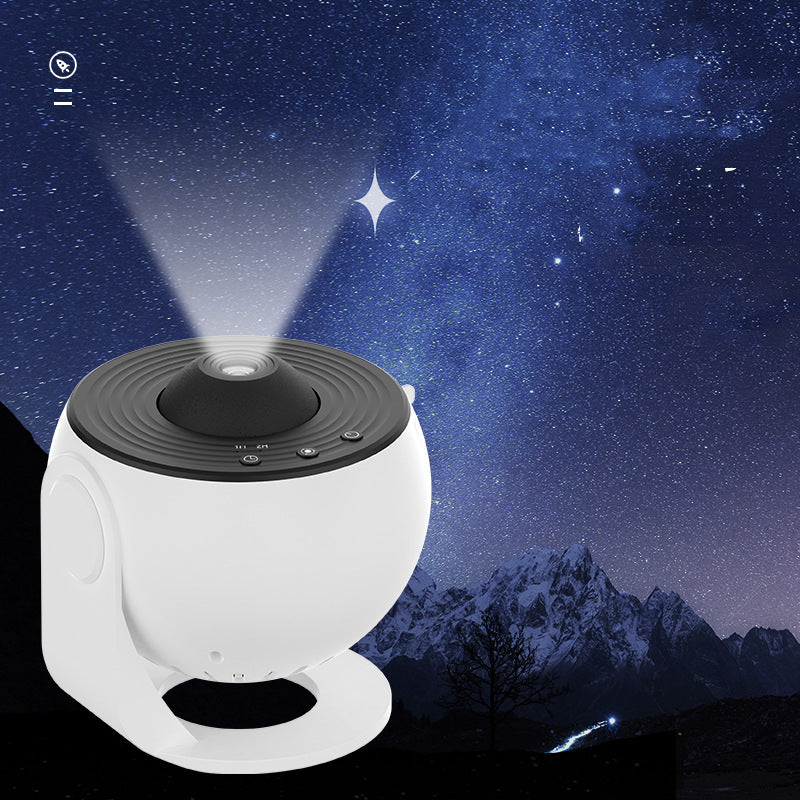
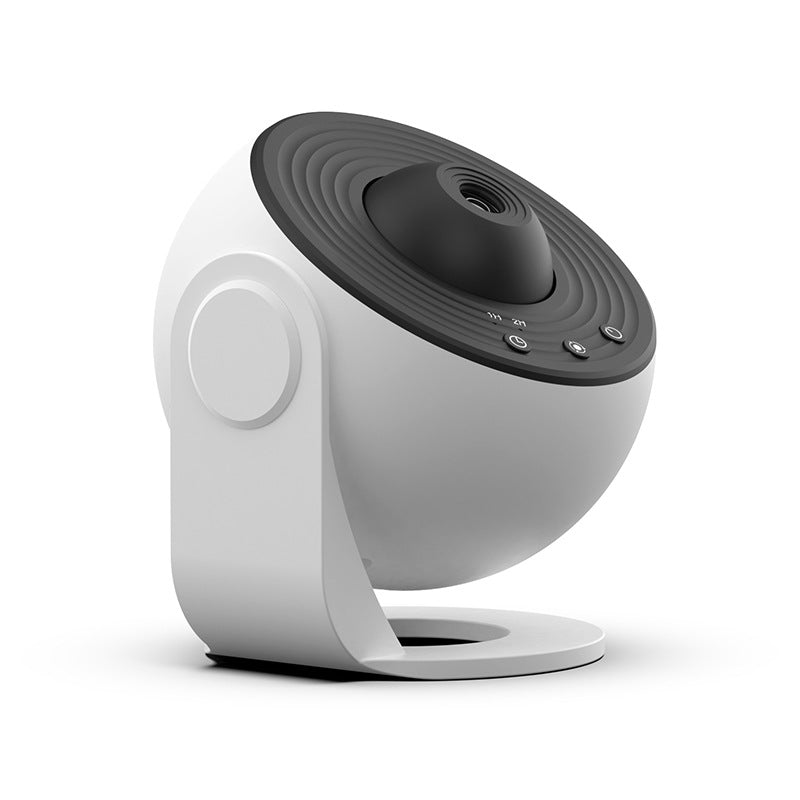


Most galaxy projectors throw a fuzzy green glow at your ceiling. This one focuses light through a real glass lens and a film disc — the same principle as a planetarium — so you get pin-sharp starfields instead of coloured blur.
Low stock — this one keeps going round TikTok
Set it up tonight. If the sky isn’t sharper than you expected, email us within 30 days and we refund it.
Order today and it should reach you by
Turn it on tonight
Same room, same bed, same ceiling. One switch and it stops being the place you can’t settle in — which is the entire reason anyone buys one of these.
I had a cheap one before and it was just a green blur on the ceiling. This one you can actually see individual stars. That’s the whole difference.
Bedtime used to take forty minutes of negotiating. Now she asks me to put the stars on and she’s out before the timer finishes.
I put it on instead of picking up my phone. Turns out lying there looking at a nebula is a lot better for me than scrolling until 1am.
Took about ten seconds to set up. Plugged the USB in, twisted the ring until it went sharp, done. No app, which I was very glad about.
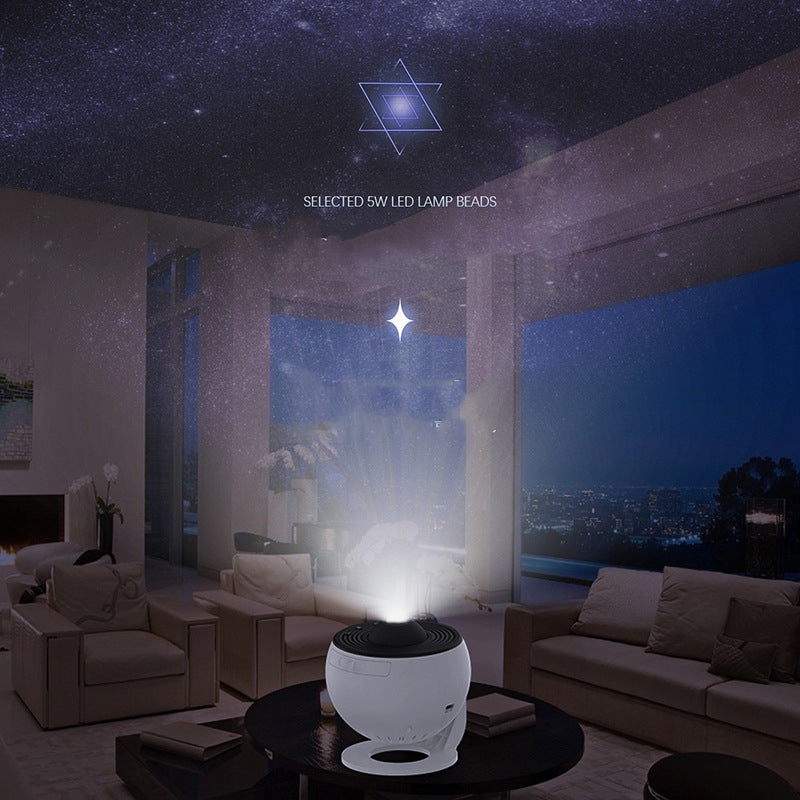
It fills the entire ceiling of a normal bedroom, not just a patch. I was expecting a small circle and got the whole room.
Swapping the discs is the part I didn’t think I’d use and now we pick a different one every night. The moon one is the favourite here.
No kids, nobody to put to bed — I bought this for me. I turn it on, the ceiling goes deep space, and forty minutes later I realise I never picked my phone up.
Nothing in this photo moved. Same bedroom, same camera, same blank white ceiling — the only change is the light going off and the projector going on.


Drag to compare — a standard bedroom, nothing added to the room
Almost every cheap galaxy projector works the same way: a bare LED behind a spinning piece of textured plastic. There is nothing focusing the light, so what lands on your ceiling is a soft coloured smear. It looks fine in the ad and disappointing in your bedroom.
LED-and-plastic projectors scatter unfocused light. Stars arrive as blobs, and the picture gets worse the further you sit from the wall.
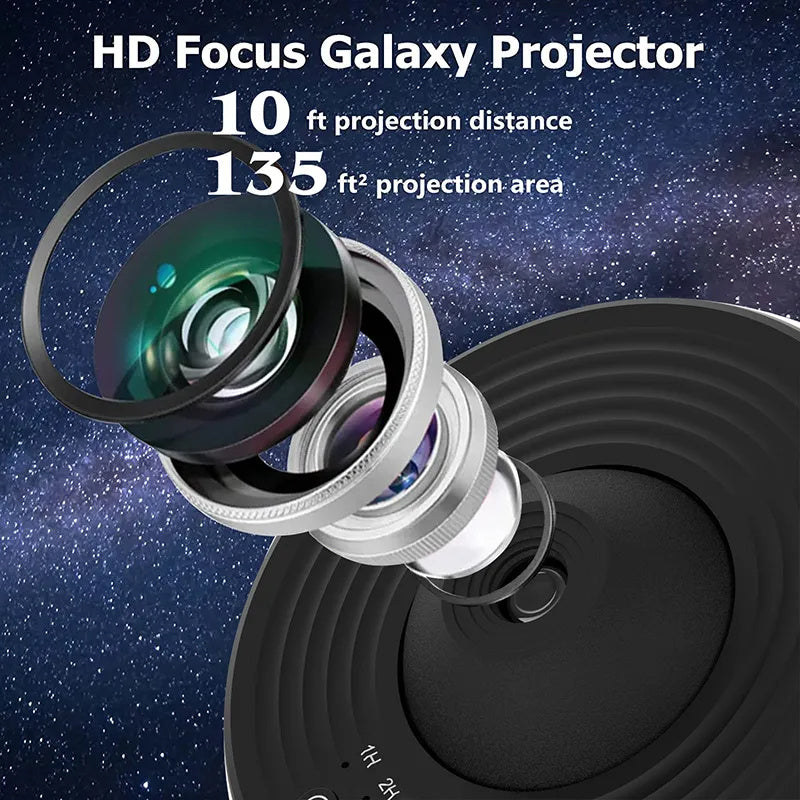
This one puts a real multi-element glass lens in front of a printed film disc — the same optical principle a planetarium uses. The image is a projected photograph, not a glow.
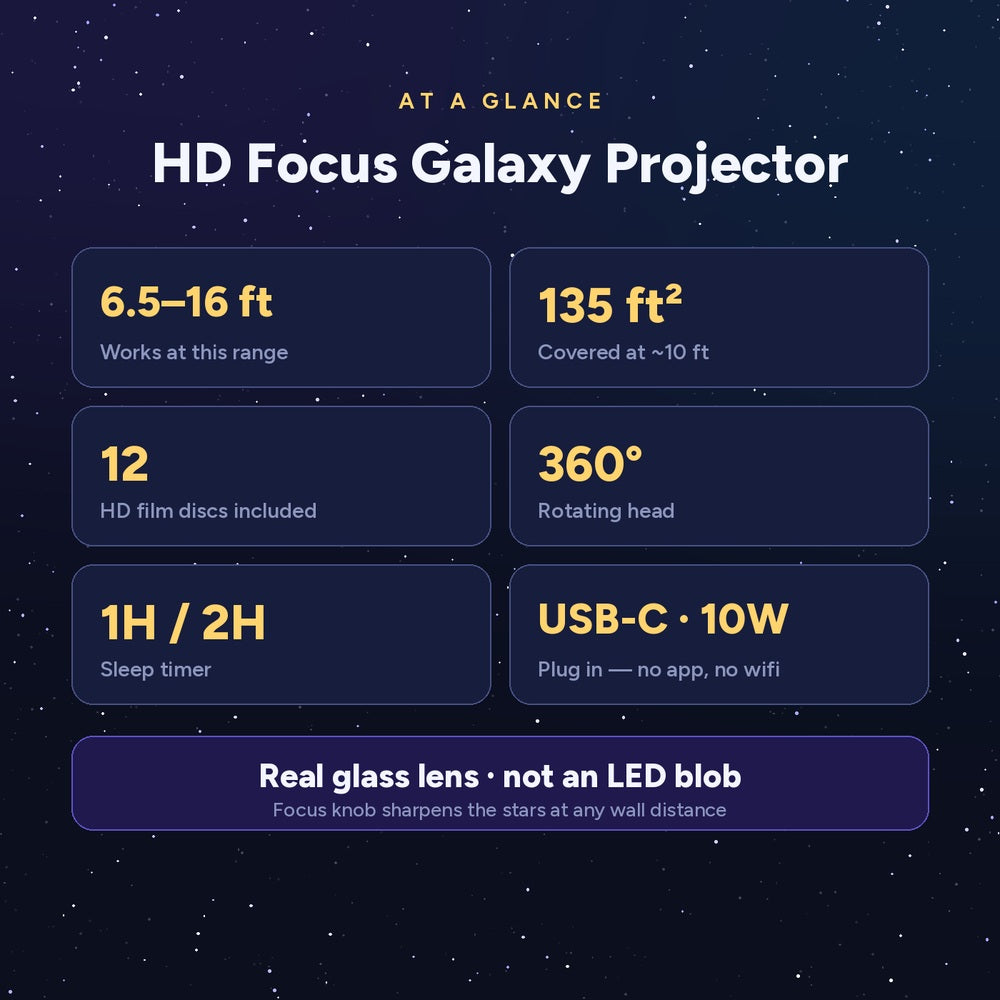
A focus knob on the lens lets you sharpen the image for your ceiling height, anywhere across its 6.5–16 ft working range.
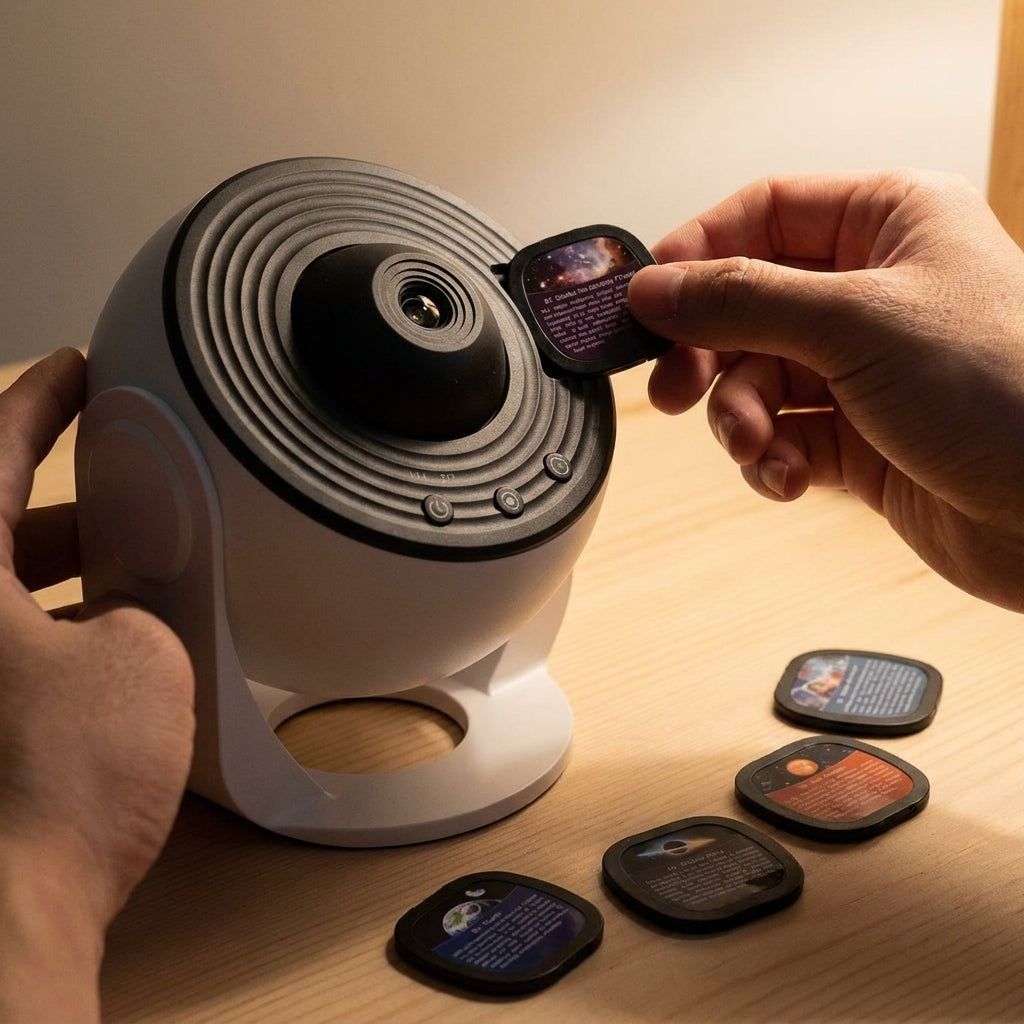
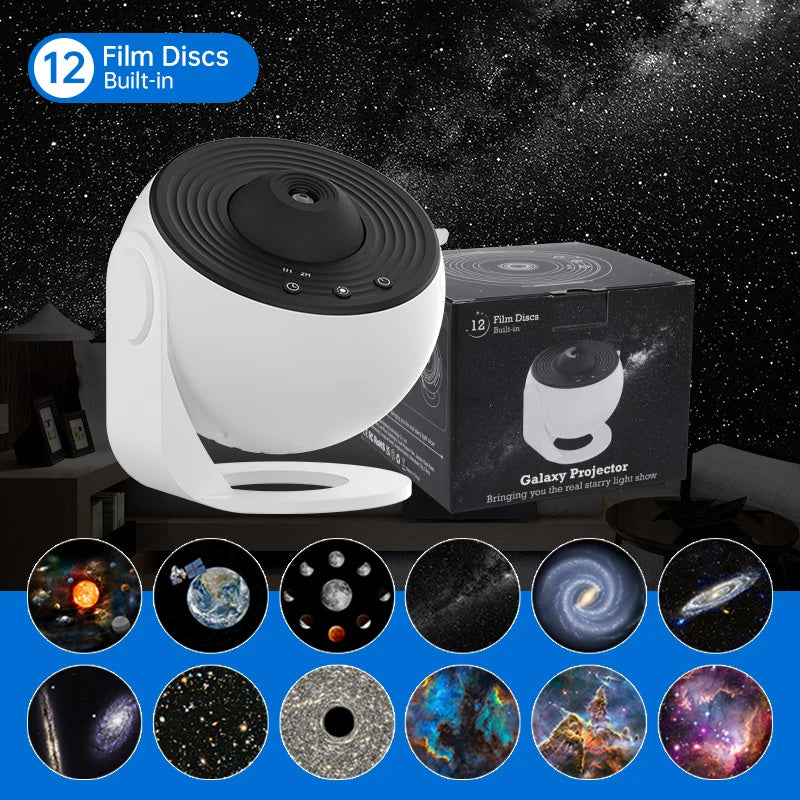
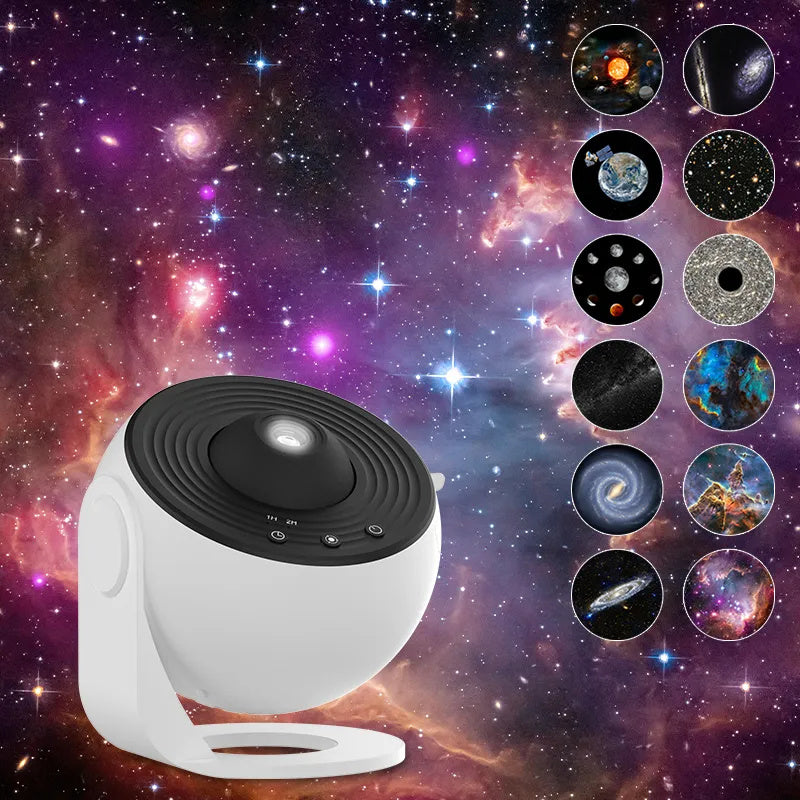
Twelve printed film discs come in the box — nebulae, the moon, planets, deep-field starscapes. Swap one in and the room changes completely.
The head turns a full circle inside its base and tilts, so you can throw the sky at the ceiling, a wall, or the corner above your bed. Two rotation speeds.
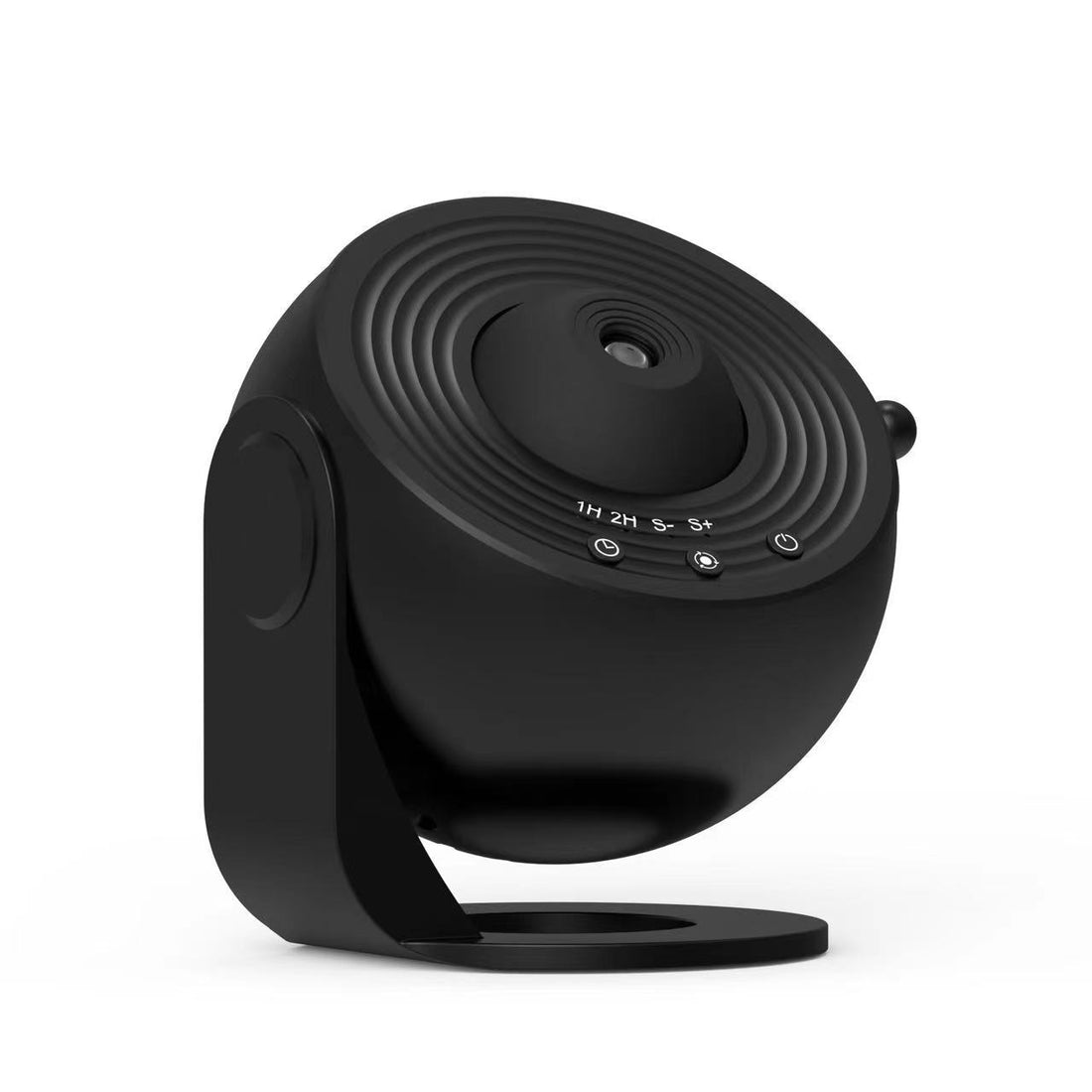
One-hour and two-hour timers. Fall asleep under it and it shuts down on its own instead of running all night.
Runs off any USB port — wall plug, power bank, laptop. Three buttons on the body. No app to install, no wifi to join, no account to make.
| Typical $25 LED projector | HD Focus Galaxy Projector | |
|---|---|---|
| How the image is made | Bare LED through textured plastic | Film disc through a glass lens |
| Star definition | Soft coloured blur | Individually resolved points |
| Adjustable focus | — | ✓ Focus knob on the lens |
| Scenes included | 1–2 fixed patterns | 12 swappable film discs |
| Coverage | A patch of ceiling | About 135 ft² at 10 ft |
| Sleep timer | Usually none | ✓ 1H and 2H |
| Setup | Often an app and an account | ✓ Plug in the USB-C |
| If you don’t like it | Marketplace returns lottery | ✓ 30-day refund, we pay attention |
The left column describes the category of sub-$30 LED projectors generally, not one named product. If you already own one, the focus knob is the difference you will notice in the first ten seconds.
Pick a sky, slide the disc into the tray on top of the head until it clicks. They are printed film, not plastic gels, which is why the picture holds together.
Any USB port. Press the power button on the body. The sky appears immediately — there is nothing to install and nothing to connect to.
Rotate the knob around the lens. The stars pull into focus for your exact ceiling height. This is the step cheap projectors do not have.
Tap the timer key for 1H or 2H if you want it to switch itself off, then aim the head wherever you want the sky. Done.
| Planetarium tickets for a family of four | $70–$110 · once |
|---|---|
| A night light that does one thing | $20–$35 |
| Smart bulbs for one room | $45–$90 |
| A white-noise machine | $35–$70 |
| HD Focus Galaxy Projector | $69.99 |
Category price ranges as advertised in the US in 2026. Ours is a one-off cost with no subscription, no bulbs and no refills.
Set it up in the room you actually want it in and use it. If the sky isn’t noticeably sharper than what you were expecting, we refund you.
Any time within 30 days of it arriving. One line is enough — you don’t have to argue a case.
Usually the same day. We’ll tell you exactly where to send it and what to include.
Refunded to the original payment method once it’s on its way back.
Two honest caveats. First, the darker the room, the better it looks — the manufacturer specifies indoor use in a dark room, and in a bedroom with a streetlight through thin curtains it will be washed out, same as any projector. Second, a camera on a long exposure always makes a projected sky look brighter than your eye sees it, and that is true of every listing in this category including ours. What the lens genuinely changes is definition: individual stars instead of a smear. That part is not a photography trick, and it is the thing you will notice first.
Between about 6.5 and 16 feet from whatever you are projecting onto — 2 to 5 metres. Closer than that and the focus knob runs out of travel before the stars sharpen, which is the single most common reason people are disappointed by one of these. At around 10 feet it covers roughly 135 square feet, which is most of the ceiling in a standard bedroom; set it further back and the sky spreads wider and dims. A nightstand or dresser aimed up at the ceiling is the sweet spot.
A built-in speaker, and nothing else. Same glass lens, same 12 film discs, same 360° head, same timers, same everything. You pair a phone to it and it plays your audio while the sky is running. It does not add an app, a remote, or extra scenes — so if you don’t want a speaker in your projector, the standard model is the identical picture for $20 less.
It draws 10W over USB and stays cool to the touch — there is no hot bulb in it, and because it works by projecting a film disc rather than firing a laser, the manufacturer rates it as safe for children’s eyes. That said, the reason we built the timer into the page is that we would rather it switched itself off: tap the timer key for 1H or 2H and it shuts down on its own. Keep the cable tucked behind the furniture and out of a cot, as with anything mains-adjacent in a child’s room.
They are printed film in a rigid holder, not a consumable — there is nothing to burn out, and handling them by the edge keeps them clean indefinitely. Twelve come in the box. We don’t currently sell replacement or extra disc packs separately, so twelve is what you have; we’d rather say that plainly than imply an add-on range that doesn’t exist yet.
Orders are processed in 1–3 business days and ship tracked and free within the US. You’ll get a tracking number by email as soon as it moves. If it hasn’t arrived when you expected it, reply to that email and we will chase it rather than pointing you at the carrier.